Showing posts with label ideation. Show all posts

Friday, October 24, 2014

Hive Labs at the Mozilla Festival: Building an Ecosystem for Innovation


This weekend marks the fifth year anniversary of the Mozilla Festival - and Hive Labs has a ton of fun design - oriented, hands-on activities to get messy with in person or remotely. We are using the event to explore design questions that are relevant to local communities and Hives and to dabble in building out a community-driven ecosystem for innovation. Here's a few highlights:

Challenges to Enacting and Scaling Connected Learning

This year, the Hive track at MozFest (http://2014.mozillafestival.org/tracks/) is bringing together Hive and "Hive curious" travelers from around the world to incubate solutions to shared challenges in enacting and scaling connected learning. We're working together over the course of the MozFest weekend to collaboratively answer questions that come up again and again in our networks across the globe. One question that Hive Labs is focusing on is: How do we build a community that supports innovation in the education space? 


Action Incubator

We will be hosting a series of activities embedded within the Hive track to think through problems in your Hives and local communities and brainstorming solutions collectively. We will be leveraging three teaching kit's that were made specifically to facilitate this kind of design thinking activity:

  • Firestarter: In this activity, participants will identify opportunities and then brainstorm potential design solutions.
  • User Testing at an Event: Events are a great time to leverage all of the different kinds of voices in a room to get feedback on an in-progress project or half-baked idea. This activity will help you to test ideas and projects and get constructive and actionable feedback.
  • Giving + Getting Actionable Feedback: Getting effective and actionable feedback on your half - baked ideas and projects can be challenging. This activity explores some ways to structure your feedback session.

Art of the Web 

This entire track is dedicated to showcasing and making art using the Web as your medium. Follow the #artoftheweb hashtag on twitter. 


in response to the #mozfest remotee challenge

MozFest Remotee Challenge

Want to join in on all of the Mozilla Festival action even though you aren't physically at the event? This challenge is for you! We have compiled a handful of activities focused on Web Literacy, supporting community - based learning and making so that you can take part in the conversation and brainstorming at the Mozilla Festival. Go here to start the challenge.

You can follow along all weekend using the #mozfest or #hivebuzz hashtags on Twitter.

Tuesday, July 15, 2014

The first 6 weeks of Hive Labs

Six weeks ago, Atul Varma, Chris Lawrence, Kat Baybrooke and I embarked on an experiment we call Hive Labs. Let me tell you about, Let me show you a little slideshow I made about our first 6 weeks to the tune of Josh Gad singing In Summer from the movie Frozen.


So, in summary (or if you aren't the musical slideshare type) the first 6 weeks have been great. We did a bunch of listening and research, including attending events and hackjams run by and for Hive members. Here's a neat worksheet from a Mouse run Webmaker training in New York. 

We did some research and design on tools and resources to support prototyping:


Sherpa is a codename for a tool that helps prototypers define a design opportunity and openly work through the process for designing a solution. We designed some mockups to see if this is a direction that we should pursue. Sherpa could be a back-end for the "Cupcake dashboard" or be a stand alone tool. We spun up an instance of the "Cupcakes" dashboard  designed by the Firefox UX team to help figure out if it is a useful tool to surface prototypes.

We also prototyped a snippet for Firefox to promote Maker Party, worked on an idea for self guided Webmaking and began work on a Net Neutrality Teaching Kit.

Finally, we've shipped some things:

The No-Fi Lo-Fi Teaching Kit asks participants the question how can we empower educators to teach the web in settings where connectivity isn't guaranteed?

With the Mobile Design Teaching Kit, participants play with, break apart and modify mobile apps in order to understand how they work as systems. This teaching kit is designed to explore a few activities that can be mixed and mashed into workshops for teens or adults who want to design mobile apps. Participants will tinker with paper prototyping, design mindmaps and program apps while learning basic design and webmaking concepts.

A local and a global Hive Learning Network directory

... and a section on Webmaker.org to help guide mentors through making Teaching Kits and Activities:


The first 6 weeks have been great, and we are going to continue to listen, create and deliver based on needs from the community. We have lots more to build. We want to do this incrementally, partly to release sooner, and partly to build momentum through repeated releases.


Monday, June 16, 2014

Mobile Design Teaching Kit

I am excited to announce that the Mobile Design Teaching Kit is up on Webmaker.org and available for testing. I have been working on this with the Appmaker and the Hive teams at Mozilla over the past month . The kit is designed for mentors to guide learners to play with, break apart and modify mobile apps in order to understand how they work as systems. This teaching kit collectively offers 12 activities that can be mixed and mashed into workshops for teens or adults who want to design mobile apps.


The kit is organized around three sets of modalities: Ideation, Design and Hacking. The thinking here is that activities could be used in workshops that take learners through everything from brainstorming an idea to, prototyping that idea and then implementing it. Additionally the kit goes from novice to expert maker in scale.

Ideation Kit
Objective: Participants will brainstorm to identify opportunities and solutions to real world problems while evaluating the appropriate platform for their design.


I have admit at that the Ideation Kit was one of my favorite kits to write because I have been teaching these design exercises for the past five years or I have gotten to a point where I realize if we combine design thinking with civic engagement projects, we can have not only more successful hack jams or maker spaces, but invested learners who are putting their skills directly into action in the communities that they are inhabiting (whether that be online or IRL).  One of the activities that I think would be particularly fun to try out is Firestarter. The goal of this activity is to get introduced to seeing your community as an inspiration for design opportunities. Participants are asked to identify design opportunities and brainstorm potential solutions. Here they will evaluate the appropriateness of their medium choice in conjunction with their opportunity space.

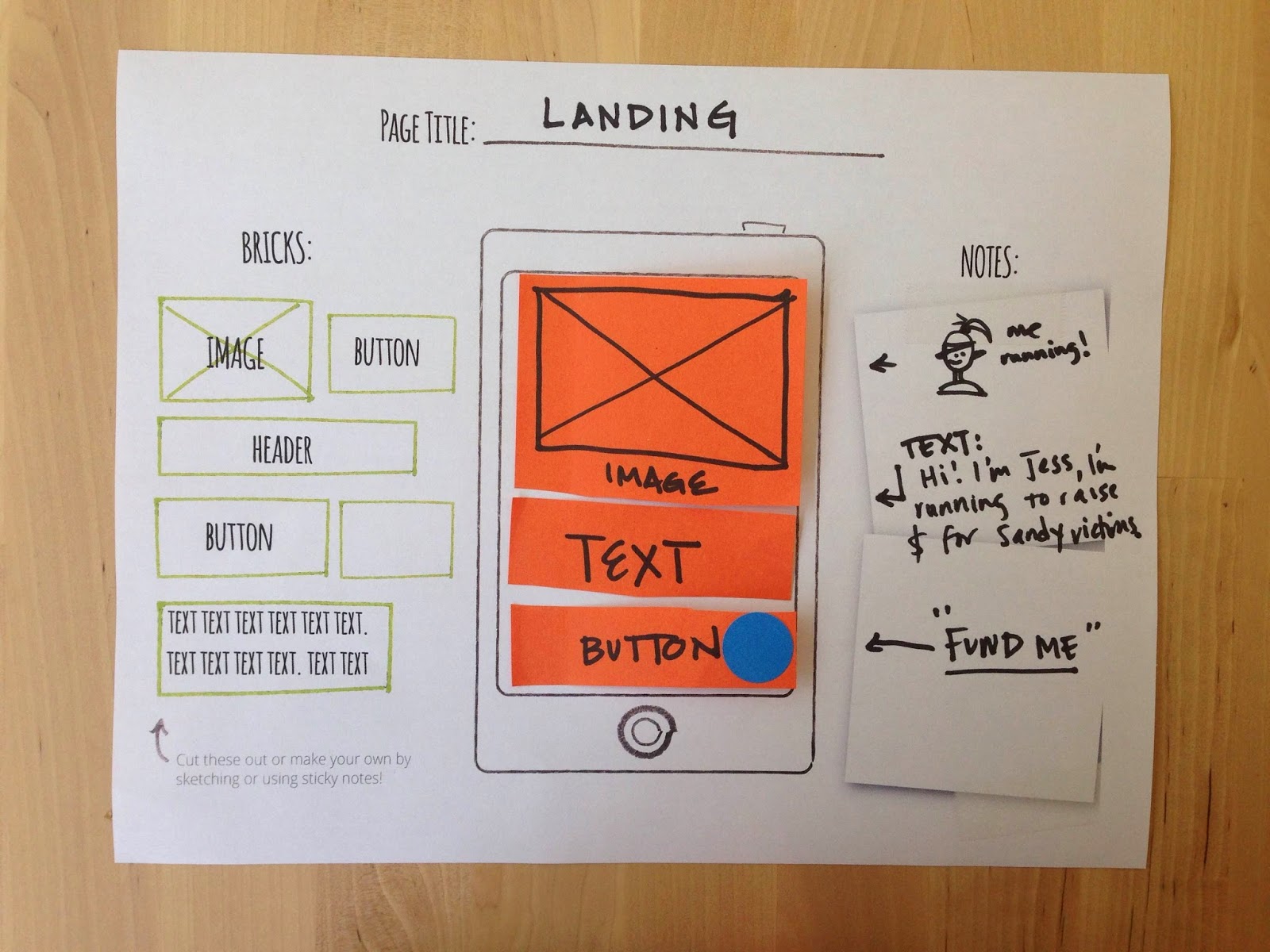
One tool that came out of this particular kit is the mobile paper prototyping template. This template (see below) is useful because it acts as a stepping stone for learners to take their ideas, prototype type them and eventually build them out with the Appmaker tool.


Design Kit
Objective: Participants will leverage their paper prototypes and use Mozilla AppMaker to create mobile apps.


With the design kit, participants user test their prototypes and are exposed to some key vocabulary and user experience design techniques. After that, there's no dancing around - this kit is all about building out mobile apps with Appmaker. Participants learn how to make apps by hacking apps.


Hacking Kit
Objective: Participants will create "brick" components for Appmaker and learn some basic coding techniques along the way.

This kit is being designed for those learners who are so invested in making apps that they want to design their own components for the Appmaker tool to use and share with the appmaking community. One tactic here for component and brick makers is to go through the exercise of designing a paper prototype of the brick and user testing that experience with potential users before hitting the ground with code.


These kits are ready to be tested out - which is another way of saying that they probably have some kinks to be worked out and refined, but we are ready and eager to here your feedback. If you have tried out the kit, have ideas or just general feedback please go here to share out your thoughts.

These kits are a collective effort from many different teams and individuals within Mozilla but I particularly want to call out Bobby,  Laura and Kat for being awesome collaborators.